
The AFRI-c trial (July, 2026) assessed whether air filters could prevent respiratory infections in care homes (nursing homes) with a published result contradicting the authors’ hypothesis that air filters can prevent respiratory infections in care homes (nursing homes). This is not the same as saying that HEPA filters don’t work.
John Mandrola’s “Lessons from the HEPA Filter RCT in JAMA-IM” was a fair report of the trial. Vinay Prasad’s follow-up (“A cluster randomized trial of HEPA filters is strikingly negative”) offering the trial as an illustration of why he has “zero trust” in public health experts, can’t be described the same way. It works actively against public health.
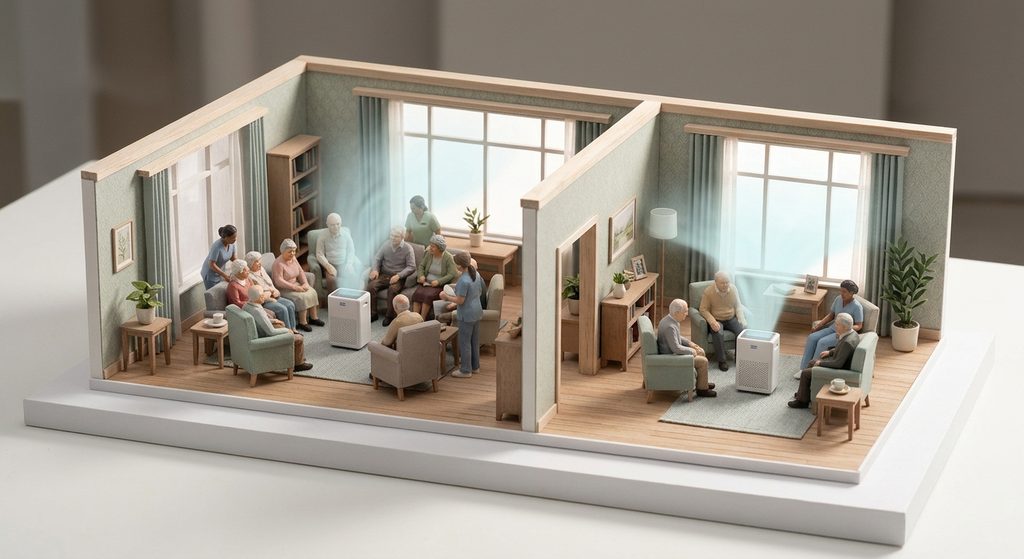
One portable air filter supplying a crowded care-home lounge vs the same filter serving a smaller group
Experts did their job
AFRI-c was funded by the National Institute for Health and Care Research, Britain’s funder of applied health research. The trial was run by a university public health department and co-authored with the UK Health Security Agency.
Ninety-one care homes were randomised to the intervention. Staff recorded resident symptoms daily using a previously validated diary, with completion rates of 97%.¹˒²
Processes were monitored. For example, the filters were turned on and correctly sited on 96% of days, few residents had non-trial filters of their own and staff did not relax handwashing or masking because a filter was in the room.¹˒²
Prespecified sensitivity analyses did not change the result, nor did excluding homes with outlier reporting rates.¹
This is public health experts working the way they should. But falling short in other ways.
Strikingly negative?
The trial was powered to detect a 50% reduction in infections. A high threshold made even more unattainable because the observed event rate – 4.2 per 1000 resident-days – was lower than expected.
Infections in residents were counted from symptoms observed by staff. 57% of residents had dementia and 61% lacked capacity¹. This means milder illness will likely have been missed in both arms of the study.
The low number of counted infections widened the confidence interval (aIRR 0.92; 95% CI 0.64–1.33), i.e., the range of true effects the data can’t exclude.² This interval still allows the possibility of smaller reductions in infections – around 25% – that would be meaningful.¹
Strikingly negative is hardly the best characterisation for such a finding.
Dose, not method
If you want cleaner air per person, you can work on the numerator (cleaner) or the denominator (number of persons).
In the trial, the HEPA filters were set based on manufacturer specifications and room volume: 160 m³/h in communal rooms (“setting 1”), and 60 m³/h in bedrooms (quietest sleep setting), chosen with residents to limit noise and draught (draft).¹ In a lounge holding a dozen residents and staff this works out as under 4 L/s per person. The ASHRAE Standard 241 for infection risk management is 2-10 times higher, specifying 10–45 L/s per person.³ The ASHRAE requirement is per occupant rather than per room as in the trial.
Actual air quality was unmeasured, making it difficult to distinguish between filters that failed to clean the air and air that was clean. The authors did recommend CO₂ or particulate monitors be used in any future trial.¹
They listed insufficient CADR (Clean Air Delivery Rate) as a potential explanation for the negative findings. But set it aside on the grounds that the added cost, noise and cooling were unacceptable to residents, noting that they could have modelled occupancy, proximity of interactions and existing ventilation to derive a more precise requirement.¹
An oncologist – someone like Dr Prasad – would not pronounce a drug inert on the strength of a trial that used it at a fraction of the tolerated dose.
Lowering the denominator
If you can’t raise the numerator, lower the denominator.
Lounge occupancy is the denominator. The care homes had a median of four resident lounges and two-thirds of residents used them more than four days a week;¹ Every occupant removed from a lounge or other gathering place gains more clean air per person in that space without the cost of noise, draught or electricity. Staggered lounge use and smaller groups in them can also be considered along with outdoor air where the weather permits, HVAC systems for ventilation, and upper-room germicidal ultraviolet devices.
What AFRI-c actually found
Two results did favour the filters – fewer days on antibiotics, and fewer days with fever or delirium in communal rooms. But the trial tested many outcomes, and some will look positive by chance alone.¹
The real result, and a more useful contribution to public health, is as follows:
At the dose that frail older people will tolerate, portable filters on their own do not reduce infections in single-occupancy care homes.
This is not the same as concluding that filtration doesn’t work, and it doesn’t apply to other settings like a waiting room where fans on higher speeds are less likely to offend.
Dr Prasad invites correction on his claim that no randomised trial has shown benefit on a clinical endpoint. None is available. The AFRI-c authors point to one earlier randomised crossover trial in residential aged care, which was also null and underpowered.¹˒⁴
Conclusion
Dr Prasad says we all eventually breathe unfiltered air somewhere and that parts of any room with filters in them go unfiltered anyway. Both statements are true but not good arguments against filtration any more than people drinking from taps we don’t control is a reason not to treat the city water supply. We treat the water where we can and accept that coverage is partial.
Respiratory infection in communal settings is about a combination of longer-range airborne particle exposure – addressed potentially by air filtering units – and close-range exposure to exhaled respiratory plumes – requiring protective masking. The ASHRAE standard refers to prevention of long-range transmission and explicitly excludes close proximity infection prevention
The right public health response is not to insist filtration works – or doesn’t – but to specify the amount and understand the purpose and limitations.
Filtration may have been oversold as a standalone intervention. The people who have demonstrated it was oversold are the public health experts Dr Prasad says he doesn’t trust.
Concluding from AFRI-c that filtration is a failed intervention rather than an insufficient one at tolerable settings is an error we will pay for in the next pandemic, and are paying for in influenza seasons now.
References
1. Hay AD, Brierley RCM, Turner N, et al. High-efficiency particulate air filters to prevent winter respiratory infections in care homes: the AFRI-c cluster randomized clinical trial. JAMA Intern Med. Published online 27 July 2026. doi:10.1001/jamainternmed.2026.2199
2. Rees S, Kipping R, Brierley RCM, et al. Implementation and acceptability of HEPA filters to reduce respiratory infections in care homes: process evaluation of the AFRI-c cluster randomised controlled trial. PLoS One. 2026;21(7):e0347989. doi:10.1371/journal.pone.0347989
3. ANSI/ASHRAE Standard 241-2023, Control of Infectious Aerosols. ASHRAE; 2023.
4. Khadar B, Sim J, McDonald VM, et al. Air purifiers and acute respiratory infections in residential aged care: a randomized clinical trial. JAMA Netw Open. 2024;7(11):e2443769.