
Under fee-for-service (FFS) medicine, doctors and hospitals are paid for activity – consultations, investigations, procedures and hospital admissions – rather than for outcomes that truly matter to patients and society.
The remedy has seemed obvious: if FFS creates the wrong incentives, change them by shifting payment from volume towards better outcomes and lower costs.
This idea, value-based care (VBC), has dominated American health policy for nearly two decades.
Has it worked? What are the lessons for South Africa?
America’s experiment
In 2010 the Affordable Care Act (“Obamacare”) created the Center for Medicare and Medicaid Innovation (CMMI) to test new payment and delivery models intended to improve quality while restraining spending.
Provider groups known as Accountable Care Organizations took responsibility for the cost and quality of defined populations. Programmes bundled payments for treatment episodes such as joint replacement. Others linked reimbursement to quality measures, readmissions and performance caring for patients with chronic disease.
Changing the incentives required a massive administrative apparatus to attribute patients to providers, estimate and adjust for risk, measure quality and construct benchmarks. Actual spending then must be reconciled against predicted spending before any savings or losses are distributed.
Funders and providers maintain their own versions of this machinery. Funders employ actuaries, analysts, coders, contracting teams, auditors and data scientists to administer the arrangements, while providers employ teams to interpret them, report against them, optimise performance and check the settlement.
VBC results
According to a 2021 assessment by the Centers for Medicare & Medicaid Services (CMS), which oversees CMMI, only six of more than 50 payment and delivery models tested in CMMI’s first decade produced statistically significant net savings; only four met the criteria for expansion (Figure 1).1

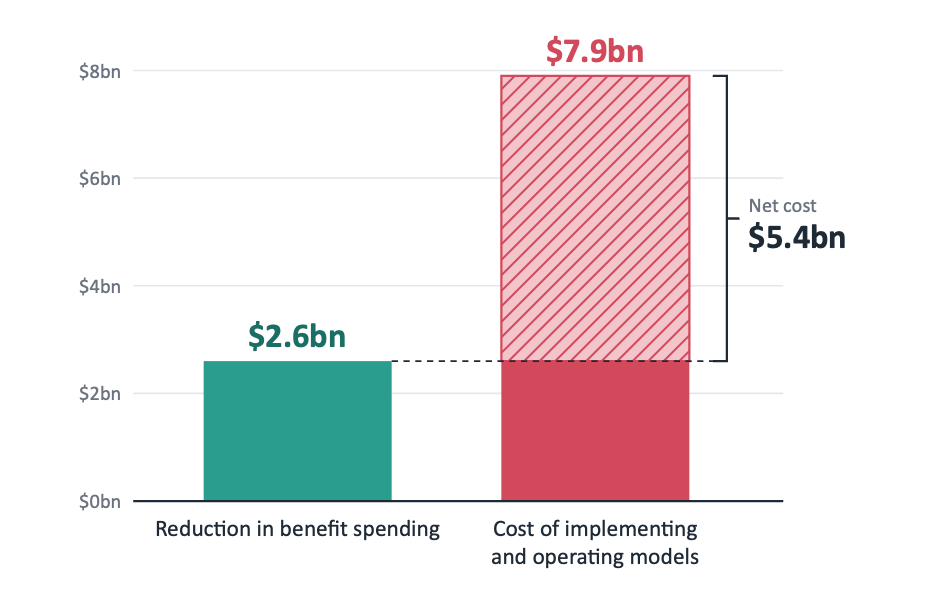
A US government budget analysis of models operating between 2011 and 2020 estimated that they had reduced healthcare benefit spending by about $2.6 billion while $7.9 billion was spent implementing and operating them – a net increase in federal spending of $5.4 billion (Figure 2).2
A review of 59 studies of value-based payment in commercial insurance found results favourable for quality, less so for spending or utilisation.3 A second review found that more intensive value-based purchasing programmes were more often associated with the desired quality, utilisation and spending outcomes.4
Since 2010, US health spending roughly doubled, reaching $5.3 trillion, or 18% of GDP, in 2024.5 VBC cannot be blamed for that, but it has not visibly bent the cost curve.
VBC as adjudication
In a recent Health Affairs article, Richard Walker argues that VBC, usually classified as a payment model, is better understood as an adjudication architecture.6
He points out that the reckoning comes months after care is delivered, once all these calculations have been completed. Only then can anyone say whether “value” was created and who owes what to whom.
An organisation that genuinely prevents admissions and improves coordination will find that its financial results depend on the technicalities of attribution, risk adjustment and benchmarking – and that the rules can change midstream. In one reported example, the standard used to judge performance in the Medicare Shared Savings Program was changed after the care had been delivered. In 2025, CMS committed to standardising model design features and minimising mid-model changes.7
For successful VBC contracting, organisations must become skilled at attribution, coding, risk adjustment, quality reporting, benchmarking and reconciliation. After more than a decade of value-based purchasing, it is fair to ask whether the value VBC adds justifies the infrastructure needed to deliver it, or whether VBC has itself become part of the problem.
Don Berwick’s warning
Donald Berwick, a leading figure in healthcare quality improvement and a former head of CMS, has criticised payment systems that reward activity while penalising prevention and coordination. He has been equally cautious about the belief that financial incentives will produce better care.
In 2005 he backed performance incentives for hospitals and health systems while expressing scepticism about pay-for-performance aimed at individual doctors and nurses.8 In 2023 he described greed as an existential threat to US healthcare, warning against making financial return its organising principle.9
Adjudication versus improvement
Mastering these rules takes a great deal of skill. A sophisticated VBC contract involves physicians, nurses, actuaries, health economists, analysts, data scientists, informaticians, project managers and executives, working on both sides to write and interpret the rules.
That is an opportunity cost, because these are the people healthcare needs for the work of improvement:
- Finding out why patients with diabetes drop out of follow-up care.
- Redesigning referral pathways.
- Standardising high-variation clinical care.
- Improving operating theatre utilisation.
- Preventing medication errors.
- Building multidisciplinary chronic-care programmes.
- Identifying avoidable admissions.
- Improving discharge processes.
The missing denominator
The administrative infrastructure needed to run VBC consumes resources: data platforms, quality reporting, risk adjustment, contract negotiation, benchmark construction, reconciliation and auditing, and clinician time spent on measurement instead of patients. Duplication on both sides of the contract adds to the bill.
Together, these amount to a second administrative system whose purpose is to determine whether the first was wasteful. That cost belongs in the denominator when judging whether VBC creates value.
Implications for SA
Several features of South African private healthcare make VBC appealing, among them substantial FFS reimbursement, fragmented care, expensive hospital utilisation and poor coordination.
Alternative reimbursement models (ARMs) have arrived. Medical schemes and administrators are already experimenting with networks, capitation, bundled payments and risk-sharing arrangements. Some encouraging results have come from relatively simple designs. The Government Employees Medical Scheme’s Emerald Value Option, which combines contracted provider networks with care coordination, reported risk-adjusted expenditure below that expected for the conventional Emerald option, along with lower-than-expected admission rates.10
Medical insurance representatives interviewed about NHI have highlighted the data, coding and administrative capacity these mechanisms require.11
In South Africa, skilled people are our scarcest healthcare resource – limited numbers of clinicians, health economists, actuaries, data scientists, informaticians and skilled managers. Every one of them assigned to building sophisticated systems for measuring value is unavailable for the work of creating it – an opportunity cost likely to weigh more heavily here than in the United States.
Minimum viable VBC
Between unreformed FFS and elaborate VBC lies a range of options (Figure 3). A purchaser can negotiate prices and build provider networks, primary care can be funded through sensible capitation, and well-defined surgical episodes can carry bundled prices. A small number of important outcomes can be measured, and multidisciplinary teams can be funded directly. Each can work without a retrospective model of what every patient’s care should have cost.

A minimum viable approach would have five steps:
- Start with the clinical problem.
- Identify the process that needs to change.
- Use the simplest payment mechanism likely to support that change.
- Measure a small number of outcomes that matter.
- Add complexity only when it produces more value than it costs.
The original insight behind VBC is fine: healthcare should reward keeping people healthy rather than simply generate billable activity.
America has spent more than a decade testing whether elaborate financial engineering is the way to achieve this, with some real successes, many disappointments and an enormous administrative infrastructure to show for it.
South Africa can learn from this experience by directing as much of its scarce capability as possible towards the work of improvement and keeping the machinery of adjudication as simple as possible. This may be a good definition of value.
References
- Centers for Medicare & Medicaid Services. Innovation Center Strategy Refresh. 2021.
- Congressional Budget Office. Federal Budgetary Effects of the Activities of the Center for Medicare & Medicaid Innovation. Washington, DC: CBO; September 2023.
- Milad MA, et al. Value-Based Payment Models in the Commercial Insurance Sector: A Systematic Review. Health Affairs. 2022;41(4):540–548.
- Pandey A, et al. Value-Based Purchasing Design and Effect: A Systematic Review and Analysis. Health Affairs. 2023;42(6):813–821.
- Centers for Medicare & Medicaid Services. National Health Expenditure Fact Sheet: Historical NHE, 2024. 2025.
- Walker RW Jr. The Category Error: Value-Based Care Is Not A Payment Model. Health Affairs Forefront. 28 September 2026.
- Sutton A. CMS Innovation Center Strategy to Make America Healthy Again. Centers for Medicare & Medicaid Services; May 2025.
- Galvin RS. “A Deficiency of Will and Ambition”: A Conversation With Donald Berwick. Health Affairs. 2005;Suppl Web Exclusives:W5-1–W5-9. doi:10.1377/hlthaff.w5.1.
- Berwick DM. Salve Lucrum: The Existential Threat of Greed in US Health Care. JAMA. 2023;329(8):629–630. doi:10.1001/jama.2023.0846.
- Willie MM, et al. The value proposition of efficiency discount options: the Government Employees Medical Scheme Emerald Value Option case study. Afr J Prim Health Care Fam Med. 2021;13(1):e1–e8. doi:10.4102/phcfm.v13i1.2292.
- Naidoo V, et al. Medical Insurance Representatives’ Perceptions on National Health Insurance Primary Healthcare Re-Engineering in South Africa: A Qualitative Study. Journal of Primary Care & Community Health. 2024;15:21501319241237044.