
In 2005, it was estimated that implementing electronic medical records could save the US more than $80 billion annually, prevent 200,000 adverse drug events1, and save tens of thousands of lives a year.
Eight years later, revisiting these predictions, the anticipated savings had not materialised and evidence that efficiency and safety had improved was, at best, inconclusive.2

EHRs happened anyway
Driven by government incentives, digitisation proceeded anyway. Today, nearly all US hospitals and most office-based doctors use electronic health records (EHRs).3 (Fax machines and pagers are still in use but that’s another story).4 Clinical information is accessible, prescriptions are electronic, test results are immediately available, and decision support is in place.
Did EHRs deliver?
Systemwide outcome benefits of EHR adoption are still hard to discern. US life expectancy lags other wealthy countries and the US spends more per person on healthcare than any other country.5 EHRs have expanded the documentation burden, with US primary care physicians spending about half the working day tapping on keyboards.6
The promise of AI
Artificial intelligence is being introduced with similar grand promises: fewer diagnostic errors, more productive clinicians, less administrative work, better patient outcomes, lower costs.
Lessons from EHRs
EHRs spread in US healthcare with surprisingly little evaluation. Implementations varied in quality but without routine measurement differences went largely unseen. When 62 US hospitals tested their order-entry systems in 2008, the median system flagged only 44% of potentially harmful medication orders, and results differed even among hospitals using the same vendor software.13 Other effects were recognised only once systems were long in place: documentation burden, new types of error, and coding changes associated with billions in extra US hospital payments each year.7
Why AI is harder
An electronic record is a defined system: a hospital buys it, installs it and turns it on.
AI is not a single software package but potentially hundreds of different tools: ambient scribes, image readers, sepsis alerts, chatbots, coding and claims software, and general-purpose models that clinicians consult on their phones. Some are built into the general purpose EHR, others are in specialised departmental systems, some are used informally. Updates occur often, and the same model may perform differently in different settings.
Also, the stakes are higher. AI can directly affect clinical decisions, errors can rapidly multiply, and model updates, which occur frequently, cause system performance to change.
What to measure
We need to understand what AI is being used for, how it changes decisions and workflow, and what happens to patients as a result. This information should be captured automatically.
Recording AI use would not, by itself, establish whether AI caused better or worse outcomes but it would make comparative studies, prospective evaluations and learning easier.
Recording AI use
Evaluation starts with knowing when AI is used.
Today there’s no standard way to record AI involvement in a patient’s care. Informal use is unrecorded.8 Nearly one in five healthcare workers use AI tools their organisation has not approved.9
David Brailer, the first US National Coordinator for Health Information Technology, has proposed a modifier code on any claim in which AI has played a material role in a clinical or administrative decision.10
Such an indicator would distinguish between AI providing information, assisting clinical decisions and acting autonomously (Figure 1).
Brailer’s code would not change payment, though he has argued that payment for AI-assisted care should be restricted to applications that are shown to improve outcomes.10
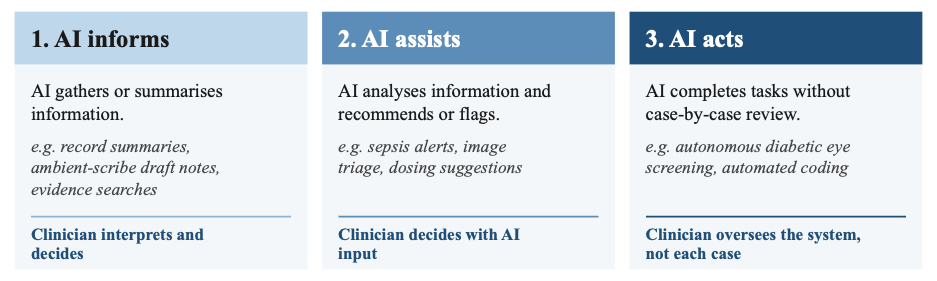
Figure 1. Three levels of AI involvement in care, based on David Brailer’s proposal. At each level, risk, responsibility and the evidence required are different.
Three uses
- Research: researchers can link these indicators to information about patient outcomes, quality, safety and costs.
- Consent: patients may wish to know when an algorithm drafted their notes, read their scan or influenced a treatment recommendation, especially when AI acts with little human review.
- Liability: when something goes wrong, a reliable record of whether and how AI contributed will help establish what happened and who was responsible.
One indicator could serve all three purposes, but in different forms: disclosure for patients at the time of care, a flag for clinicians in the record, and an audit trail for regulators and courts.
Building blocks
The HL7 AI Transparency on FHIR initiative is developing technical standards to record AI involvement; these do not evaluate AI performance or detect undisclosed use.11
The American Medical Association already allocates AI-enabled services to one of three tiers (assistive, augmentative and autonomous) for billing purposes.12
Implications for SA
We start without universal electronic record adoption; a 2018 review found that more than half of public health facilities still relied on paper files.14 AI may offer a shortcut. Ambient scribes and similar tools could help some services leapfrog from paper to digital records.15 If this happens, AI use will need to be recorded from the outset.
Local healthcare organisations need not wait for American coding systems. They could agree now on a common way to record AI use. Doing this costs little, reconstructing it later may be impossible.
The lesson from EHRs is that technology delivers its promise only when the way care is organised changes with it. AI will be no different, and we cannot manage what we do not measure.
In twenty years, AI may be as ubiquitous as electronic records are today. We should be able to say what it has contributed to health and healthcare value, and have the data to change course where needed.
Next
In the next article, we’ll explore why AI might increase spending even if it improves care, and why economic incentives are as important as the technology itself.
References
1. Hillestad R, Bigelow J, Bower A, et al. Can electronic medical record systems transform health care? Potential health benefits, savings, and costs. Health Affairs. 2005;24(5):1103–17. https://www.healthaffairs.org/doi/10.1377/hlthaff.24.5.1103
2. Kellermann AL, Jones SS. What it will take to achieve the as-yet-unfulfilled promises of health information technology. Health Affairs. 2013;32(1):63–8. https://www.healthaffairs.org/doi/10.1377/hlthaff.2012.0693
3. Office of the National Coordinator for Health Information Technology. National trends in hospital and physician adoption of electronic health records. HealthIT.gov Quick Stats. https://www.healthit.gov/data/quickstats/national-trends-hospital-and-physician-adoption-electronic-health-records
4. Kantor G. Why pagers are ancient relics – but still alive in the hospital. Health Systems Action; 2024. https://health-systems.co.za/why-pagers-are-ancient-relics-but-still-alive-in-the-hospital/
5. Gunja MZ, Gumas ED, Williams RD II. U.S. health care from a global perspective, 2022: accelerating spending, worsening outcomes. Commonwealth Fund; January 2023. https://www.commonwealthfund.org/publications/issue-briefs/2023/jan/us-health-care-global-perspective-2022
6. Arndt BG, Beasley JW, Watkinson MD, et al. Tethered to the EHR: primary care physician workload assessment using EHR event log data and time-motion observations. Annals of Family Medicine. 2017;15(5):419–26. https://doi.org/10.1370/afm.2121
7. Brailer D. Why AI will accelerate health care inflation. Health Affairs Forefront. 11 June 2026. https://www.healthaffairs.org/content/forefront/why-ai-accelerate-health-care-inflation
8. Noori A, Boussina AE, Ho Bich H, et al. A global log for medical AI [preprint]. arXiv:2510.04033; 2025. https://arxiv.org/abs/2510.04033
9. Wolters Kluwer Health. Wolters Kluwer survey finds broad presence of unsanctioned AI tools in hospitals and health systems [press release]. 22 January 2026. https://www.wolterskluwer.com/en/news/wolters-kluwer-survey-finds-broad-presence-of-unsanctioned-ai-tools-in-hospitals-and-health-systems
10. Brailer D. AI will accelerate inflation because it cannot deliver value in today’s health care market. Health Affairs Forefront. 14 October 2026. https://www.healthaffairs.org/content/forefront/ai-accelerate-inflation-because-cannot-deliver-value-today-s-health-care-market
11. National Institute of Standards and Technology. HL7 AI Transparency on Fast Healthcare Interoperability Resources (FHIR). https://www.nist.gov/programs-projects/hl7-ai-transparency-fast-healthcare-interoperability-resources-fhir
12. American Medical Association. CPT Appendix S: AI taxonomy for medical services and procedures. https://www.ama-assn.org/practice-management/cpt/cpt-appendix-s-ai-taxonomy-medical-services-procedures
13. Metzger J, Welebob E, Bates DW, Lipsitz S, Classen DC. Mixed results in the safety performance of computerized physician order entry. Health Affairs. 2010;29(4):655–63. https://www.healthaffairs.org/doi/10.1377/hlthaff.2010.0160
14. Katurura MC, Cilliers L. Electronic health record system in the public health care sector of South Africa: a systematic literature review. African Journal of Primary Health Care & Family Medicine. 2018;10(1):a1746. https://doi.org/10.4102/phcfm.v10i1.1746
15. Kantor G. Hey Siri, write my notes: can SA leapfrog from paper to electronic medical records? Health Systems Action. https://health-systems.co.za/hey-siri-write-my-notes-can-sa-leapfrog-from-paper-to-electronic-medical-records/